
Source: The Reporter
Alarmed by growing security issues along the Red Sea trade corridor, Ethiopian officials have proposed the establishment of a National Maritime Information Centre.
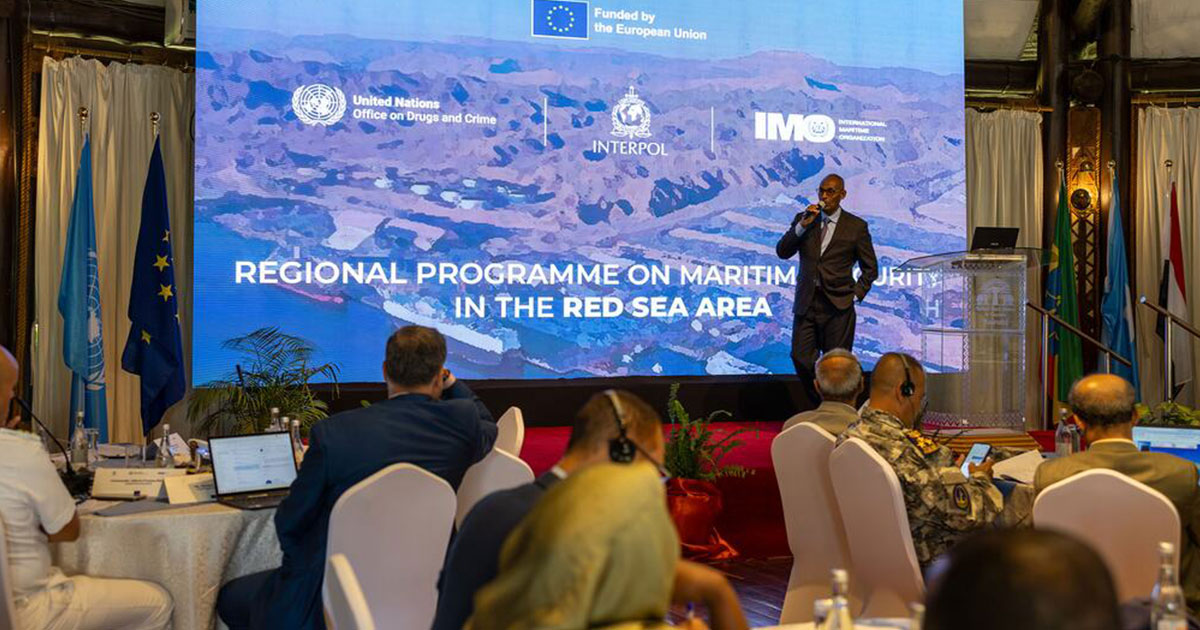
The proposal and requests were made by Captain Kibru Mesfin of the Ethiopian Maritime Authority during a regional summit held in Nairobi this week. The fifth Regional Maritime Law Enforcement Dialogue brought together security officials from Ethiopia, Yemen, Djibouti, and Somalia in the Kenyan capital.
Organized by the UN Office on Drugs and Crime (UNODC) in collaboration with the European Union, INTERPOL, the International Maritime Organization (IMO), and IGAD, the dialogue focused on rising operational threats in the Red Sea and Gulf of Aden corridors.
Officials highlighted that broader global security distractions, such as maritime tensions in the Strait of Hormuz, leave the Gulf of Aden exposed, giving pirate networks opportunities to exploit reduced regional patrols.
“For landlocked Ethiopia, maritime security is about more than law enforcement. It is an economic necessity,” reads a UN statement issued after the summit. “As maritime tensions ripple across parts of the Middle East, security officials from Ethiopia, Yemen, Djibouti and Somalia gathered in Nairobi this week to tackle a shared concern: how to protect the Red Sea and Gulf of Aden from growing threats that no country can manage alone.”
Beyond piracy, delegations addressed shared threats including illegal fishing, human trafficking, migrant smuggling, narcotics smuggling, and maritime terrorism.
Kibru emphasized that maritime security is an economic imperative for landlocked Ethiopia, given its reliance on Djibouti trade corridors. Disruptions directly surge freight and insurance costs, delay essential imports, and hinder export capacity.
Ethiopia proposed establishing a National Maritime Information Centre alongside harmonized, cross-border intelligence-sharing mechanisms with Djibouti, Yemen, and Somalia to improve real-time maritime domain awareness.
“If you are talking about threats, the current attacks on the freedom of navigation in the Strait of Hormuz have an impact on the Gulf of Aden because [they are] affecting maritime security. Pirates use this opportunity and the distraction of the maritime forces globally to do more attacks in this area, because they know that everyone is busy [looking in another direction],” said Abdurrahim Muhammad Ali of the Djibouti Maritime Authority.
Kibru argued that stronger links between maritime authorities, coast guards and law enforcement agencies across the region are essential to keeping trade flowing. He called for more organized and harmonized systems for sharing maritime information among neighboring countries, including Djibouti, Yemen and Somalia.
Establishing a National Maritime Information Centre and strengthening regional connections, he said, would help authorities access timely information needed to support maritime security and decision-making.
Mostafa Elbanna, UNODC’s regional coordinator for the Red Sea and Gulf of Aden under its Global Maritime Crime Programme, noted the region faces a complex mix of interconnected challenges.
“[This is a great time] to have this kind of discussions and dialogue with different agencies and law enforcement to talk about their challenges, and also the way forward when it comes to maritime security,” he said.
Among the chief concerns are piracy, illegal fishing, trafficking in persons, migrant smuggling and narcotics trafficking. Officials say developments in one part of the region increasingly have consequences elsewhere, making information-sharing and coordinated responses more important than ever.
While piracy levels remain well below their peak more than a decade ago, Elbanna noted that countries are now better equipped to respond through stronger law enforcement, improved data collection and greater regional cooperation.
Officials from across the region stressed that the threats they face are often the same, regardless of national borders.
Throughout the dialogue, participants discussed ways to improve maritime domain awareness, strengthen operational cooperation and develop more coordinated responses to incidents at sea.
What came through loud and clear was that in a region where criminal networks and security threats move easily across borders, cooperation remains one of the most effective tools for protecting seafarers, safeguarding trade and maintaining stability along some of the world’s busiest shipping routes.
A week ago, Ethiopia’s Ministry of Foreign Affairs held a strategic consultation to support the preparation of its annual trend analysis document for the new fiscal year. Held under the theme “Ethiopia and Interconnected Geopolitical and Geoeconomic Trends,” the consultation brought together several stakeholders to assess developments shaping Ethiopia’s national, regional, continental, and global environment.
Scholars and researchers from Addis Ababa University, think tanks, and national and international research institutions took part. Opening the event, State Minister of Foreign Affairs Ambassador Hadera Abera said the trend analysis is particularly important in light of rapidly changing and unpredictable regional and global geopolitical and geoeconomic developments. He stressed the importance of understanding these interconnected developments proactively and scientifically in order to formulate appropriate policy responses.
Hadera further underlined Ethiopia’s commitment to continue its contribution to peace and security as a member of the African Union Peace and Security Council, and its efforts to promote the Green Legacy initiative at the continental level and support the African Union’s institutional reform process.
He described the current regional, continental and global environment as complex, dynamic and interconnected, emphasizing that strategic consultations of this nature provide an important platform for scholars and experts to exchange ideas and contribute to comprehensive strategy formulation.