
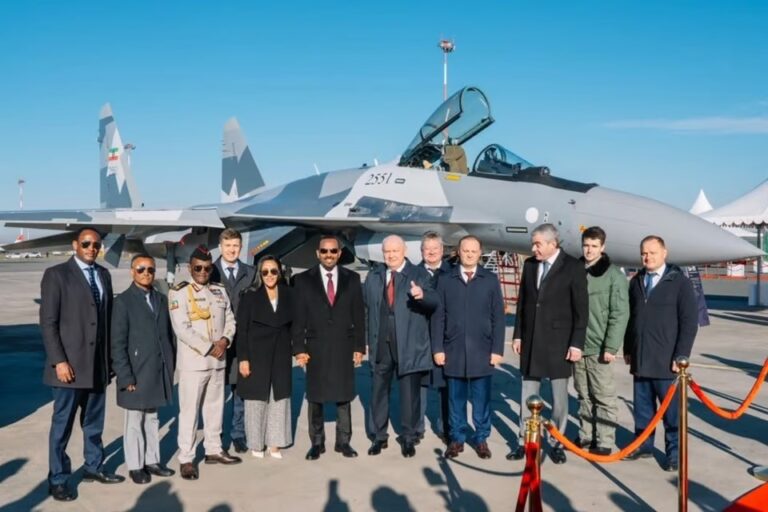
Source: Voice of Emirates
What are the details of the delivery of the Russian military shipment to Addis Ababa and what are the dimensions of the Russian initiative to ease tensions with Asmara?
Moscow – On October 28, 2026, Ethiopian Prime Minister Abiy Ahmed announced that his country had received the first batch of 12 Russian Su-35 multirole fighter jets a full year ahead of schedule, while simultaneously revealing plans to acquire four batteries of the advanced S-400 air defense system, in a move that accelerates the strengthening of Addis Ababa’s military capabilities in conjunction with the escalation of the conflict with Eritrea.
Official announcement at the Moscow summit and details of the deal
Abiy Ahmed’s announcement came during his visit to Moscow to attend the third Russia-Africa Summit, where Ethiopian state media reported that he attended the official handover ceremony for the aircraft, accompanied by Russian officials.
“Today, in accordance with our previous agreement with the Russian government, we received the first twelve fourth-generation Su-35 4++ fighter jets,” Abe said in a statement on social media.
The Ethiopian leader praised Russian President Vladimir Putin for speeding up the delivery process by 12 months, confirming that Addis Ababa will also receive four batteries of the S-400 system.
The published images showed an aircraft bearing light gray camouflage and the Ethiopian flag on its tail, along with the serial number (2551). The size of the announced deal exceeds previous indications derived from leaked Rostec documents from October 2025, which suggested the purchase of only six fighter jets, reflecting an expansion of the defense agreement between the two countries.
Air Force modernization and introduction of the “S-400”
The Su-35 (4++ generation) fighters, equipped with two AL-41F1S engines, thrust vectoring systems, and Irbis-E radar, add high combat capabilities to the Ethiopian fleet, joining the Su-30K fighters introduced in January 2024 and the Yak-130 aircraft, along with the fleet of drones that includes the Turkish Bayraktar TB2 and Akinci, the Chinese Wing Loong II, and the Iranian Mohajer 6.
Ethiopia’s anticipated acquisition of four S-400 batteries would expand its ground-based air defense capabilities beyond its current Pantsir-S1 systems, moving the country into the list of international operators of the system alongside China, India and Turkey.
Escalating confrontation with Eritrea and Moscow’s mediation
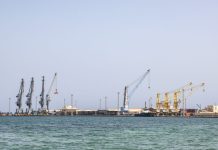
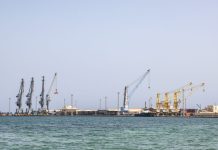
This military upgrade comes amid deteriorating Ethiopian-Eritrean relations, with Addis Ababa accusing Asmara of supporting the Tigray People’s Liberation Front and armed groups, while Eritrea accuses Ethiopia of seeking to use force to gain access to the Red Sea and the port of Assab.
The escalation had seen the closure of embassies and the expulsion of diplomats on October 1, followed by Ethiopia’s invocation of Article 51 of the UN Charter for the right to self-defense on October 10, in response to Eritrea’s demand for Security Council intervention under Chapter VII.
The visit coincides with Russian Foreign Minister Sergey Lavrov’s announcement that Moscow is ready to facilitate and host talks between the two governments to ease the crisis, with Eritrean President Isaias Afwerki attending the Moscow meetings.