
Source: Horn Review
In the Horn of Africa, history under Isaias Afwerki does not merely rhyme. It repeats with disciplined consistency. A familiar sequence unfolds. Eritrean forces project power across the border into Ethiopian territory. The move is denied, minimized, or reframed as defensive necessity. Ethiopia responds to protect its sovereignty. Asmara then pivots to the language of pure victimhood, appealing to the United Nations, international law, and regional opinion as the aggrieved party facing unprovoked aggression. The recent events in the borders of the two states follow this template with almost textbook precision of May 1998. Eritrean troops advanced into Ethiopia’s Tigray region. The United Nations Secretary-General expressed concern over their presence. Ethiopia invoked its inherent right of self-defense. Eritrea immediately asked the Security Council for deterrent measures against Ethiopia. On 6 to 12 May 1998, Eritrean mechanized units, brigades supported by tanks and artillery, entered the Badme area and adjacent territories under Ethiopian administration. Skirmishes with local forces escalated rapidly. Ethiopia acted to defend its territory. Eritrea’s narrative cast the operation as a response to prior provocations and as the reclamation of rightful land. The subsequent two-year conflict became one of the bloodiest interstate wars in modern African history, with estimates of seventy to one hundred thousand dead.
The legal reckoning was unambiguous. The Eritrea-Ethiopia Claims Commission, established under the 2000 Algiers Agreement, ruled that Eritrea had violated the United Nations Charter by initiating the use of force and invading Ethiopian territory. Eritrea had been the first mover across the administered line. Militarily, the war followed a predictable arc. Eritrea scored early gains and dug into fortified positions. Ethiopia absorbed the initial shock, mobilized its larger population and resources, and in May 2000 launched a decisive multi-front offensive. Ethiopian forces broke through Eritrean lines, advanced deep into Eritrean territory, and forced Asmara to accept a ceasefire from a position of clear military inferiority. The Algiers Agreement followed. Eritrea later received a favorable delimitation on Badme, yet the military reality remained defeat. It had initiated the war and lost it on the ground. The regime survived only by locking the country into permanent mobilization, isolation, and repression, the foundations of the garrison state that still exists today. Throughout the conflict and its long aftermath, Eritrean state messaging emphasized Ethiopian expansionism and bad faith. The fact that Eritrea had fired the opening shots and occupied Ethiopian-administered land was systematically inverted. Victimhood became both a diplomatic posture and a domestic legitimizing tool.
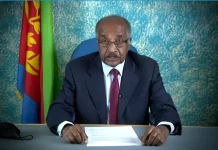
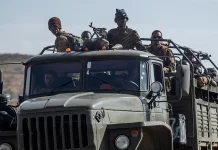
The current sequence mirrors the earlier one with uncomfortable fidelity. Multiple independent accounts documented Eritrean forces and convoys operating well inside Ethiopian territory in early October, advancing tens of kilometers south of the border. Ethiopia described the operation as an all-out invasion, reported advances of up to sixty kilometers, and invoked Article 51 self-defense. The United Nations Secretary-General’s spokesperson stated on October 9 that the Secretary-General was further concerned by reports of the presence of Eritrean forces in Ethiopia and reminded regional states of their Charter obligations against the threat or use of force and against interference in internal affairs. Eritrea’s response was pure continuity. Information Minister Yemane Gebremeskel issued a lengthy statement framing years of Ethiopian discussion of legitimate national interests as an ongoing unprovoked war of aggression lasting more than three years. He cited Abiy Ahmed’s October 2023 parliamentary remarks on the existential importance of sea access for a landlocked nation of more than one hundred twenty million people, subsequent references to historical and legal questions surrounding independence, and statements by Ethiopian officers. From this catalogue of words, Yemane concluded that Ethiopia had been waging aggression in flagrant breach of the United Nations Charter, while Eritrea had shown exemplary restraint. The statement carefully avoided any admission that Eritrean forces were operating inside Ethiopia. By elevating Ethiopian discussion of its national interests into continuous armed aggression, it sought to invert the facts on the ground and render Eritrean military presence secondary and defensive, the same inversion performed in 1998. The decisive issues are therefore not which capital sent the first letter to New York, but whether Ethiopian sovereignty was violated by the presence of foreign forces and which party created the conditions for escalation by placing those forces across the border. A state that has projected military power across an international border cannot simultaneously claim the moral and legal high ground of a threatened party requiring international protection.
Under the United Nations Charter, the threat or use of force against the territorial integrity of another state is prohibited. Self-defense under Article 51 requires an armed attack. A sovereign nation is fully entitled to discuss and pursue vital national interests, including reliable access to the sea, without that discussion being converted into a casus belli by a neighbor. Treating years of Ethiopian strategic discourse as continuous armed attack that somehow justifies Eritrean mechanized units operating deep inside Tigray is a profound distortion of international law. It reveals a regime that regards the sovereignty of others as negotiable while demanding absolute protection for its own. Before any credible appeal for United Nations intervention can be made, the elementary requirement remains the withdrawal of those forces from Ethiopian territory. Until that occurs, Eritrea’s call for international action is compromised and self-serving, functioning less as a genuine request for peace than as an attempt to internationalize a situation it helped create through its own forward military posture.
What distinguishes the present episode is the evidence that this is not merely a recurring rhetorical habit but a deliberate, centrally coordinated strategy. The timing of the deployments is instructive. Eritrean forces moved into Tigray precisely as Ethiopian federal forces were engaged in renewed fighting against internal armed groups in the north. The military movements were not random border incidents. Multiple reports describe organized convoys of troops and heavy equipment advancing tens of kilometers inside Ethiopian territory in a coordinated manner. These movements were then immediately followed by a highly disciplined diplomatic campaign. Within days, the highest levels of the Eritrean state, speaking through Yemane Gebremeskel and formal letters to the Security Council, produced a unified narrative that denied or minimized the presence of their own forces while casting Ethiopia’s defensive response as the originating aggression. The consistency of messaging across military action and diplomatic communication, the speed with which the narrative was activated, and the alignment of both with the broader strategic objective of keeping Ethiopia constrained all point to direction from the centre rather than improvised reaction. The same sequence of forward military presence followed by coordinated claims of victimhood was executed in 1998. The repetition after nearly three decades indicates institutional learning inside the Eritrean state, not coincidence.
The post-2018 history of the port issue further exposes the pattern. After the peace declaration, there were high-level conversations between the leaders of the two countries about economic cooperation, including potential use of Assab and Massawa. Ethiopia approached these discussions in good faith, seeking arrangements that would serve mutual benefit. Eritrea initially signaled openness but then refused practical implementation of road links, commercial arrangements, or any functional give-and-take model. The refusal left Ethiopia dependent on a single foreign port while denying Eritrea the revenue and stability that genuine cooperation would have brought. When Ethiopia continued to articulate its legitimate needs, Asmara treated that articulation itself as aggression. The sequence is consistent with a long-standing Eritrean preference for keeping Ethiopia constrained and vulnerable rather than accepting a stable regional order based on mutual interest.
Several structural factors lock Eritrea into this behavior. The Isaias system is a highly personalized, militarized autocracy that has never successfully demobilized or diversified its economy. Permanent external threat is not merely a policy choice; it is a regime-survival mechanism. The perception of continuous danger from Ethiopia has for decades provided the principal justification for indefinite national service, a system that extracts labor and loyalty from the population while severely restricting emigration and independent economic activity. Militarization in turn concentrates political and economic power in the hands of the ruling party and the senior military elite, who control key sectors of the economy and the coercive apparatus. A genuine normalization of relations with Ethiopia would remove the central narrative that legitimizes these arrangements. Demobilization would reduce the military’s institutional dominance, open space for alternative sources of authority, and expose the economic failures that the external threat has long obscured. The leadership’s consistent rejection of practical cooperation after 2018, its rapid return to confrontational posture whenever Ethiopian internal challenges create an opening, and its disciplined cultivation of a siege mentality all indicate that the regime perceives these outcomes as direct threats to its own survival. External confrontation is therefore not an unfortunate byproduct of unresolved border issues. It is a functional requirement of the political system that Isaias has constructed.
The unresolved strategic contradiction over the Red Sea reinforces the cycle. Ethiopia’s quest for reliable sea access is a legitimate national interest for the most populous landlocked country in the world. Eritrea’s determination to deny that interest and to control the coast as an instrument of leverage has produced repeated instability. When internal challenges in Ethiopia create perceived windows of opportunity, the temptation to shape outcomes through forward military presence reappears.
Yet the asymmetry that Eritrea consistently underestimates remains decisive. Ethiopia is vastly larger in population, economy, and potential mobilization. In 2000 that asymmetry eventually prevailed despite early Eritrean advantages in readiness and fortifications. In 2026 Ethiopia possesses additional strengths, including combat experience from recent campaigns, expanded drone and air capabilities, and a government prepared to defend its territory. Eritrea’s army remains large relative to its population and is battle-hardened, but it operates under severe constraints of manpower sustainability, logistics, and international isolation. The 2000 outcome is therefore instructive. Eritrea could initiate and temporarily hold ground. It could not sustain a war of attrition or decisive maneuver against a fully mobilized Ethiopia. When the larger power committed, the smaller initiator was forced into a disadvantageous settlement. Isaias survived that round by turning defeat into a narrative of resistance and by tightening internal control. Survival came at the price of national development, mass emigration, and permanent militarization.
There is no structural reason to assume the outcome would be fundamentally different if the present confrontation escalates into sustained fighting. An Eritrean force operating deep inside Tigray is exposed. Prolonged conflict would risk the same dynamic that unfolded in 2000, Ethiopian concentration of force, progressive degradation of Eritrean positions, and eventual pressure that forces Asmara back toward a ceasefire from a position of relative weakness. For ordinary Eritreans and Ethiopians, another round of high-intensity fighting along the same corridors would produce new casualties, displacement, and economic destruction. For Isaias personally, each cycle consumes more of the country’s human capital and deepens isolation. The regime’s ability to absorb another military setback without internal fracture is not infinite.
The tragedy is that the script is so well-rehearsed that its next act is legible in advance. The central question remains what happened on the ground, whether Ethiopia’s sovereignty was violated, and who bears responsibility for the escalation. Before any appeal to the United Nations can carry moral or legal weight, the forces deployed deep inside Ethiopian territory must be withdrawn. Ethiopia, larger and currently cohesive in its determination to defend its territory, is positioned to impose costs. History suggests those costs will again fall hardest on the initiator. Whether Isaias can once more convert military adversity into regime longevity is the open question. The pattern itself is no longer open to serious doubt.
By Dagim Yohannes, Researcher, Horn Review